Regulation is not killing Innovation Done properly, it protects good ideas, filters out harmful ones, and gives serious builders the confidence to invest long‑term.
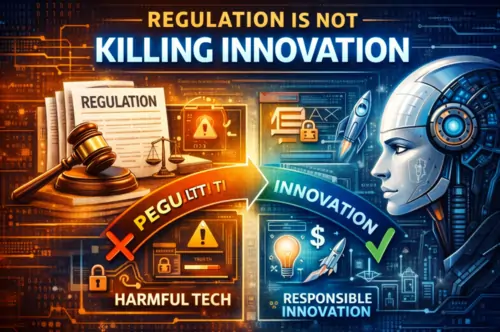
Table of Contents
This isn’t just theory—policy experts and regulators increasingly argue that well‑designed rules can enable innovation by stabilizing markets and building trust in new technologies, not least in AI and digital finance. For example, the World Economic Forum has highlighted how regulation now shapes innovation as much as technology itself. Regulation now shapes innovation as much as technology
Regulation is not Killing Innovation: Not Enemies, But Partners
There’s a common fear in tech:
“Too much regulation will kill innovation.”
Sounds logical, right?
More rules = more restrictions = slower progress.
For readers who want a deeper dive, the European Union’s official page on the AI Act and its risk‑based framework explains how different levels of risk map to different obligations, while the OECD AI Principles set out high‑level standards for trustworthy, human‑centric AI adopted by dozens of countries.
But history shows something different. Smart regulation does not kill innovation. It shapes it. In many cases, regulation actually strengthens innovation, builds trust, and creates long‑term growth.
Let’s unpack this properly, step by step.
What People Really Mean by “Regulation Kills Innovation”
When people complain that regulation harms innovation, they usually mean:
- Compliance costs are high.
- Startups face more paperwork.
- Approval processes slow product launches.
- Legal risk feels heavier.
All that is real. Regulation does create friction.
But friction is not the same as failure.
Seatbelts created friction for car manufacturers too—extra parts, extra tests, extra cost. Today, no one seriously argues against them. In fact, we’d never get into a car that doesn’t have basic safety built in.
Innovation Without Rules Can Collapse Trust
Innovation can move very fast.
Public trust moves much slower.
If technology harms users—even once in a big, visible way—trust can collapse overnight.
You see this pattern:
- Data privacy breaches → Stronger data protection laws.
- Financial fraud → Tighter banking and fintech compliance.
- Unsafe medicines → Strict clinical trials and approvals.
- AI bias and discrimination → Calls for AI governance and audits.
Regulation often appears after harm. It is a response mechanism. Without it, markets become unstable.
If consumers don’t trust a technology, adoption slows or reverses. It doesn’t matter how solid your tech is—if people don’t dare to use it, there is no sustainable growth.
So regulation doesn’t just react to innovation; it protects innovation from collapsing under public backlash.
Regulation Creates Clear Rules of the Game
Innovation thrives in predictable environments.
When companies understand:
- What is allowed.
- What is restricted.
- What standards must be met.
They can plan better and move faster within those boundaries.
Examples:
- Data protection rules (like GDPR‑style frameworks) clarify how personal data can be collected, stored, and used.
- Financial regulations define capital, reporting, and conduct requirements so banks and fintechs know the lines they cannot cross.
- Aviation safety standards tell airlines and manufacturers what “safe enough” means.
Without regulation, uncertainty increases risk. And investors really don’t like uncertainty.
Clear frameworks reduce guesswork, lower perceived risk, and attract capital. Regulation and innovation become aligned: build something new, but build it inside a well‑understood playing field.
Regulation Increases Consumer and Enterprise Trust
Trust is an economic asset.
People and businesses are more willing to adopt a new product when they know:
- Their data is protected and not abused.
- Products are tested and meet safety standards.
- AI systems are accountable and explainable.
- Financial systems are monitored, not wild‑west.
No trust → No users.
No users → No scale.
For enterprise buyers and governments, this is even stronger. They ask:
- “Is this compliant?”
- “Can this be audited?”
- “What happens if something goes wrong?”
Regulation gives you credible answers to those questions. That turns “compliance” from a cost center into a growth enabler.
You can also view this through the lens of market externalities: without rules, companies can offload the social cost of harms (like bias, misuse of data, or systemic risk) onto users and society. Regulation forces those costs back into the system so there is no “race to the bottom” where the cheapest, least responsible model wins.
Strong Regulation Encourages Better Design
When companies must meet standards, they are forced to design better systems.
In AI, for example:
- Transparency requirements encourage more explainable models.
- Fairness and bias checks push teams toward better data, better sampling, and more robust testing.
- Documentation requirements improve reproducibility and handover.
In fintech:
- Compliance rules drive stronger fraud detection and transaction monitoring.
- Identity verification standards reduce abuse and money laundering.
Regulation pushes teams to think beyond “Can we build this?” into “Can we deploy this responsibly?” That mindset shift increases long‑term innovation quality.
Good innovators use regulation as a design constraint, not just a blocker.
History Shows Regulation and Innovation Co‑Exist
We don’t have to guess. We can look at real industries.
Aviation
Air travel is one of the most regulated sectors in the world.
Yet it remains highly innovative: safer planes, more efficient engines, better navigation, automation, optimization.
Safety regulation built public trust. Without safety standards, people would avoid flying. With them, the industry scaled globally.
Pharmaceuticals
Drug development faces strict clinical trials, multi‑phase testing, and detailed approvals. Does that slow things? Yes. But it also:
- Protects patients.
- Maintains confidence in medicines.
- Prevents a few bad actors from ruining the entire industry’s reputation.
Without regulation, one unsafe drug could destroy confidence in a whole class of treatments.
Financial Systems
Banking regulation strengthened after crises and scandals.
Today, compliance frameworks help prevent systemic collapse.
Stability doesn’t kill financial innovation—it enables it. It gives room for digital banking, payments innovation, and new credit models to grow inside a safer system.
Regulation Filters Out Harmful “Innovation”
Not all innovation is good innovation.
Some products and models:
- Exploit users.
- Misuse or quietly sell data.
- Manipulate markets.
- Increase inequality or exclusion.
Regulation helps filter out the worst behaviour. That protects responsible innovators.
If bad actors dominate a space, good companies suffer:
- Users get burned and leave.
- Governments overreact later.
- Reputation damage hits everyone.
So regulation can actually level the playing field, making sure innovation competes on quality and trust—not just on who is willing to cross the most ethical lines.
AI Regulation: A Modern Case Study
AI brings this debate into sharp focus.
Some people say: “If you regulate AI too much, progress will slow.”
But look at what AI already touches:
- Hiring and recruitment.
- Credit scoring and lending.
- Healthcare triage and diagnostics.
- Law enforcement and risk prediction.
- Education and access to opportunities.
Mistakes here are not just “minor bugs.” They affect real lives. Bias can scale at machine speed.
That’s why AI governance frameworks focus on:
- Transparency and explainability.
- Risk classification (low, high, unacceptable).
- Human oversight and intervention.
- Accountability and auditability.
These principles do not exist to block innovation. They exist to make it safe enough for governments, enterprises, and the public to adopt AI at scale. No one will rely on AI in critical systems if there are zero rules.l
If you want to see how this looks in practice, especially for systems that make high‑stakes decisions, our guide on AI fairness audits breaks down how structured reviews can detect bias, protect users, and keep AI deployments compliant without slowing real innovation.
When Regulation Goes Wrong: Overregulation and Regulatory Capture
Being pro‑regulation does not mean pretending all rules are good.
Two real risks are:
- Overregulation – Rules that are vague, outdated, or overly strict for low‑risk use cases.
- Regulatory capture – When large incumbents shape regulation in their favour because they are the only ones who can afford the lawyers, audits, and lobbying.
Regulatory capture can:
- Lock smaller startups out of the market.
- Turn “compliance” into a moat for big players.
- Reduce competition and, ironically, slow real innovation.
Acknowledging this matters. Smart policy should:
- Scale requirements with risk and size (lighter obligations for small, low‑risk players; heavier for large, high‑impact systems).
- Involve diverse stakeholders (startups, SMEs, civil society, technical experts), not just the biggest companies.
- Use sandboxes and pilots so new ideas can be tested safely without full regulatory burden from day one.
Legal scholars sometimes frame this as a “false choice” between regulation and innovation—arguing that the real problem is how we regulate, not whether we regulate at all. A useful perspective on this comes from work like The False Choice Between Digital Regulation and Innovation, which explores how poorly calibrated rules can entrench incumbents rather than foster fair competition.
The goal is not regulation that only giants can navigate. The goal is a fair, open environment where responsible innovation from companies of all sizes can thrive.
Old vs New Innovation Mindset
You can think of the shift like this:
| Mindset | Old Model: “Move Fast & Break Things” | New Model: “Build Fast & Last” |
|---|---|---|
| View of regulation | Blocker to avoid | Design constraint to embrace |
| Speed vs safety | Speed first, fix later | Speed with guardrails |
| Trust | Assumed, not designed | Designed and measured |
| Externalities | Pushed onto users/society | Accounted for in the product |
| Advantage | First to market | Safest and most trusted to scale |
This shift from “move fast and break things” to “build fast and last” is visible across multiple sectors—from Web3 and crypto, where thoughtful regulation is finally separating real projects from noise, to AI, where structured rules are helping serious players differentiate from opportunistic ones. Crypto tokens in 2026: Why regulation is finally separating real projects from noise
How to Keep Innovating Under Regulation (Practical Playbook)
Bring compliance in early
Don’t treat legal and compliance like “the people who say no.” Bring them into:
- Early brainstorming.
- Product design.
- Risk assessments and pilots.
It’s cheaper and faster to adapt early than to rebuild everything later.
Build governance into your product
Make governance a feature, not just an internal checklist:
- Clear logs and audit trails.
- User controls for consent, privacy, and data usage.
- Explanations for automated decisions where possible.
This helps with regulation and builds user trust.
Document your trade‑offs
When someone asks “Why did you design it this way?”, you should be able to show:
- Risks you identified.
- Options you considered.
- Decisions you made and why.
This shows maturity and makes regulators, partners, and investors more comfortable backing your innovation.
Turn compliance into a selling point
Instead of saying “we have to comply,” say:
- “We design for safety, fairness, and accountability from day one.”
- “Our system is audit‑ready and enterprise‑grade.”
- “We treat governance as part of our product strategy.”
In 2024–2026, being the safe AI or fintech choice is often more profitable than being the first.
Why Regulation and Innovation Need Each Other
Innovation without regulation can lead to chaos.
Regulation without innovation leads to stagnation.
The future belongs to systems where both coexist.
Responsible companies already understand this. They build with compliance in mind from day one. They know:
- Trust is infrastructure.
- Governance is strategy.
- Accountability is competitive advantage.
So no—regulation is not killing innovation. It is maturing it. The real competitive edge now is not “move fast and break things,” but “move fast and build things that last.”

